917 reviews
 Mon – Thurs: 7:30 AM – 6:00 PM
 5530 Crackersport Rd Allentown, PA 18104
 (610) 395-2514
An appraiser spends about fifteen minutes with your car. He walks it, reads the dash, checks the tires, looks under the hood for wet spots, then plugs in a scan tool that tells him everything you hoped he wouldn’t ask about.
That short walk decides thousands of dollars. Schearer’s both sells used cars and services European ones in Allentown, so we see both sides of the appraisal, and the cars that hold their number all have a few things in common.
Quick Summary: Key Takeaways
- Records win: a folder of factory maintenance history is worth more than a detail, especially on an Audi, BMW or Mercedes.
- Kill the lights: any lit airbag, ABS or check engine lamp moves a car into the reconditioning pile and drops the offer.
- Sticker time counts: a Pennsylvania inspection with ten months left reads as value, while an expired one reads as an unknown cost.
- Second key matters: a missing spare fob can cost a few hundred dollars on a European car, since replacements need programming.
- Match your tires: mismatched brands or uneven tread on an all-wheel-drive car raises drivetrain questions you don’t want asked.
Service records move the number more than a wash does
Documentation is the cheapest value you can add. Show a folder or a printed history with oil services at the right intervals, brake fluid every two years and the big items handled, and a buyer reads the car as maintained rather than merely driven.
Gaps invite discounts. On a BMW or a Mercedes, an appraiser who can’t see recent service assumes the timing chain guides, the cooling system and the plugs are all still due, then prices that guess into the offer. Print the history. Staple the receipts.
Warning lights and stored codes cost real money at appraisal
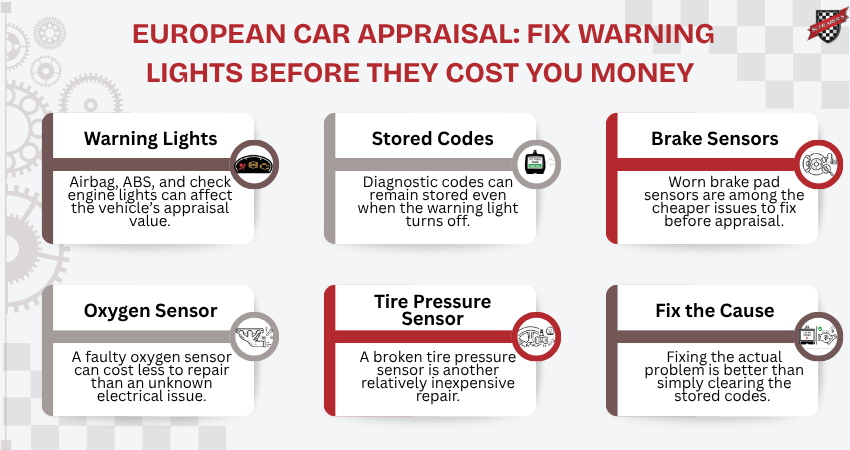
Lit lamps are red flags with dollar amounts attached. Airbag, ABS and check engine lights all get read in seconds with a scan tool, and stored codes stay in memory even when the light is off.
Cheap fixes pay here. Worn brake pad sensors, a lazy oxygen sensor or a broken tire pressure sensor cost a fraction of what a dealer deducts for an unknown electrical problem, and the difference usually lands in your pocket rather than theirs. Clear nothing. Fix the cause.
Pennsylvania inspection status is part of the offer
Fresh stickers are bargaining chips. Pennsylvania requires an annual safety inspection and an emission inspection in Lehigh County, and a car sold with ten months left is worth more than the same car needing one next week.
Buyers do the same math you do. Private buyers ask about the sticker before the second phone call, and an expired inspection invites an offer built around whatever the worst case might be. Get it inspected. Then sell it.
Tires, glass and small cosmetics are judged in seconds
Tires get looked at first, and mismatched brands or uneven tread on a quattro or xDrive car suggests neglect and drivetrain wear. Pressure counts. The Department of Energy notes that keeping tires properly inflated improves gas mileage by 0.6 percent on average, and properly inflated tires stay safer and last longer.
Glass counts. Windshield chips fail inspection when they sit in the wiper path, and a burnt LED module reads to an appraiser as an electrical problem waiting to happen. Curb rash on a wheel costs less to refinish than the deduction it earns.
Know which repairs to skip before you sell
Not every repair pays you back. Say the car needs a $3,000 air suspension job and the trade deduction runs $1,500. Do the math, then sell it as it sits with the problem disclosed.
We’ll tell you which is which. Our pre-sale inspection puts a number on every open item, then you decide what to fix and what to declare, and that conversation beats a guess from an online valuation tool. Fix the cheap stuff. Disclose the rest.
Allentown drivers can inspect, repair and trade in one place
We’re on Crackersport Road in Allentown, and we run a used car lot alongside the service side. That means the same shop that has cared for your Volvo can inspect it, tell you what an appraiser will find, and make you an offer on it.
Two jobs, one shop. Loaner vehicles and a shuttle keep you moving while the work happens, and drivers from Bethlehem, Emmaus, Macungie and Orefield use us for both halves of the transaction.
Frequently Asked Questions
Q: What should I fix before trading in my car?
A: Anything cheap that reads as a problem: burnt bulbs, worn wipers, warning lights, a missing second key, low tires and a windshield chip in the wiper path. Skip big-ticket repairs that cost more than the deduction.
Q: Does a detail increase trade-in value?
A: Clean helps, but only a little. Service records, a valid inspection and no warning lights move the number far more than a wash and wax do.
Q: Should I get an inspection before selling my car in PA?
A: Usually yes. Current Pennsylvania safety and emission stickers remove an unknown cost from the buyer’s mind, and a pre-sale inspection tells you what to fix and what to disclose.
Q: Is it better to trade in or sell a European car privately?
A: Private sales often bring more money, though they take time and paperwork. Trades are faster and can offset tax on the next car, so compare the real numbers rather than the headline price.
Find out what your European car is really worth
Book a pre-sale inspection and we’ll show you what an appraiser will see, item by item. Reach out through the contact page and we’ll get you on the schedule.
Hours: Mon-Thu 7:30 AM-6:00 PM; Fri-Sun closed
Website: schearers.com