917 reviews
 Mon – Thurs: 7:30 AM – 6:00 PM
 5530 Crackersport Rd Allentown, PA 18104
 (610) 395-2514
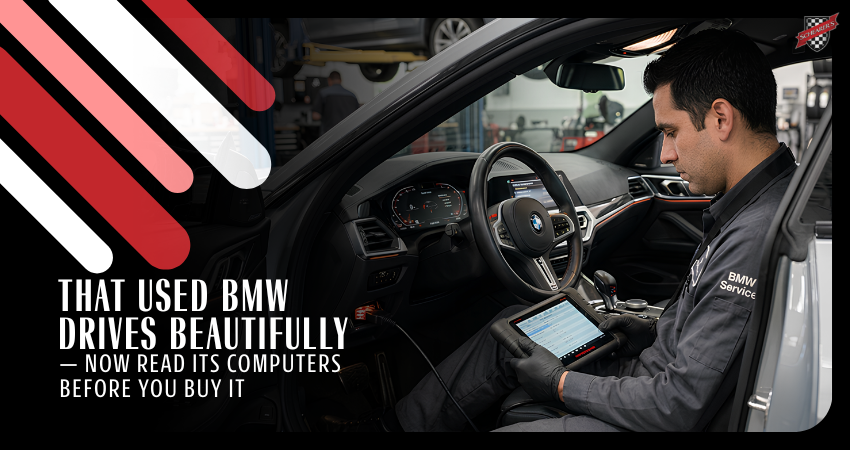
The car is clean, the seller is pleasant, and it drove perfectly around the block. Nothing on the dash. Twenty-eight thousand dollars and a signature away from being yours.
A twenty-minute test drive cannot see stored history, and the computers can. Every module in a modern European car keeps its own fault memory, and a proper scan in Allentown pulls records the seller may not know exist. We both sell used cars and repair them here, which is exactly why we would rather you scan one before buying than after.
Quick Summary: Key Takeaways
- Modules remember: Faults stay in memory long after the warning light goes out.
- Cleared codes leave a trail: Incomplete readiness monitors on an otherwise clean car mean somebody erased something recently.
- Adaptations tell the truth: Fuel trims and transmission adaptation values reveal wear a test drive hides.
- Recalls are free and often open: NHTSA recalls covered more than 29 million vehicles in 2025, and many stay unrepaired.
- Calibration follows glass and bumpers: A repaired car with driver-assist cameras needs ADAS calibration.
What a Full Module Scan Reads That a Code Reader Misses
A parts-store reader talks to the engine computer and stops. A modern BMW, Mercedes or Land Rover carries dozens of modules — transmission, ABS, airbag, body, gateway, driver assistance, climate — and each keeps its own memory.
Scanning all of them changes the picture. An airbag module holding a crash-sensor fault, a gateway with a coding mismatch, an ABS module quietly logging a wheel-speed dropout — none of that reaches the dashboard, and all of it shows up the moment somebody asks each module directly.
This is the difference between a car that looks fine and a car that is fine. Fault memory does not care how well the seller detailed the interior.
Cleared Codes Announce Themselves If You Know Where to Look
Someone erased something. That is the honest reading of a car with zero stored faults and half its emissions monitors marked incomplete, because monitors only reset when codes are cleared or power is lost.
Timing matters here. If the seller says the car has been driven daily for months, the monitors should all be complete, and a clean-but-unready car is a fifteen-minute-old repair or a fifteen-minute-old deletion.
Pennsylvania makes this concrete. A vehicle with incomplete monitors will not pass the state emission inspection, so what looks like paperwork becomes your bill within weeks of buying.
Adaptation Values Show Wear That No Test Drive Reveals
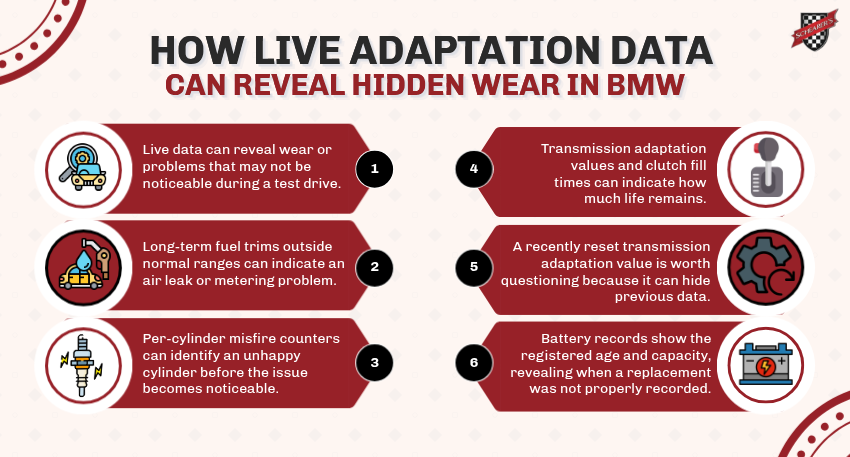
Live data is where the real story sits. Long-term fuel trims well outside normal mean an air leak or a metering problem, and per-cylinder misfire counters show which cylinder is unhappy before you can feel it.
Transmissions keep records too. Adaptation values and clutch fill times on a ZF eight-speed or a Volkswagen DSG indicate how much life is left, and an adaptation that has been reset recently is worth asking about.
Battery data closes the loop. BMW and Mercedes systems record the battery’s registered age and capacity, so a car with a five-year-old registered battery and a shiny new one under the hood tells you the replacement was never recorded properly.
Open Recalls Are Free Repairs Nobody Told the Last Owner About
Check the VIN before you check the tires. NHTSA reports that more than 29 million vehicles were recalled in 2025, and it notes that millions of those repairs go unperformed every year.
Second and third owners miss the letters. Registration changes hands, the notice goes to an old address, and the car keeps driving with an open safety campaign against its name. Nobody ever finds out.
The upside is that recall work is free at a franchise dealer regardless of who owns the car now, so an open recall is a bargaining chip rather than a dealbreaker.
Driver-Assist Systems Need Calibration After Any Real Repair
Cameras and radar have to be aimed. A replaced windshield, a new bumper cover, an alignment after suspension work — any of those can shift a sensor enough that lane keeping and automatic braking read the road wrong.
A scan finds the evidence. Stored driver-assistance faults, a camera reporting a blocked or unlearned state, or a radar with no completed calibration all indicate work that was done without the final step.
We do ADAS calibration here, and we would rather tell you about it before you own the car. It is a real line item, and it belongs in the price you negotiate.
Lehigh Valley Buyers Get the Same Bench Either Way
We sit on both sides of this. Schearer’s sells used vehicles and services them, so the technicians who would eventually fix your car are the ones who can scan it before you buy it — and the diagnostic side of that work is what earned us 2025 Bosch Module Shop of the Year.
The shop is at 5530 Crackersport Road in Allentown, minutes from Route 22 and I-78, and we handle Audi, BMW, Jaguar, Land Rover, Maserati, Mercedes-Benz, MINI, Porsche, Volkswagen and Volvo, plus Tesla and EVs.
Buyers come from Bethlehem, Emmaus, Macungie and Easton. Bring the car, or bring the listing.
Frequently Asked Questions
Q: What does a pre-purchase module scan show on a used car?
A: Stored and pending faults in every module, the conditions present when each fault set, emissions readiness status, fuel trims, misfire counters, transmission adaptation values, and coding mismatches. None of it shows on a test drive.
Q: How can I tell if a seller cleared the check engine light?
A: Look at the emissions readiness monitors. Clearing codes resets them, so a car with no stored faults but several incomplete monitors was almost certainly scanned and erased recently, or had its battery disconnected.
Q: Should I check for recalls before buying a used car?
A: Always, and it takes two minutes with the VIN on the NHTSA site. Open recalls are repaired free by a franchise dealer no matter how many owners the car has had, and a long-open campaign tells you something about how the car was maintained.
Q: Is a pre-purchase inspection worth it on a European car?
A: On a car where a single control module can cost four figures, yes. The scan and inspection cost a small fraction of one avoidable repair, and the findings usually move the price more than they cost.
Scan the Car Before the Money Moves
Bring the vehicle in, or send us the listing and we will tell you what to look for. A full module scan and inspection turns a hopeful purchase into an informed one.
Hours: Mon-Thu 7:30 AM-6:00 PM; Fri-Sun closed
Website: schearers.com