917 reviews
 Mon – Thurs: 7:30 AM – 6:00 PM
 5530 Crackersport Rd Allentown, PA 18104
 (610) 395-2514
Quick Takeaways:
- European cooling systems run under pressure at precise temperatures, so a small leak that hides all winter becomes a roadside failure in summer.
- Plastic coolant parts – expansion tanks, thermostat housings, water pump impellers – are the most common failure points, and heat accelerates them.
- The first warning signs are subtle: a sweet smell, a creeping gauge in traffic, or a low-coolant message that keeps returning.
- An overheating event can warp a cylinder head or fail a head gasket in minutes, turning a routine repair into a major one.
- Schearer’s Sales and Service at 5530 Crackersport Rd performs cooling system pressure testing for European vehicles.
Allentown summers do not match Phoenix for raw heat, but humid 90-degree afternoons, stop-and-go traffic on Tilghman Street and Hamilton Boulevard, and the climbs toward South Mountain put European cooling systems under sustained load. A system that limped through winter with a marginal thermostat or a hairline crack often holds until the first hot stretch, then fails at the worst moment – idling on Route 22. Schearer’s Sales and Service has spent years diagnosing these failures and knows the BMW, Audi, Mercedes, Volkswagen, Porsche, and Volvo cars common here share predictable summer cooling weak points.
Why do European cooling systems fail in Allentown’s summer heat?
European engines run at a tightly controlled temperature, often 200 to 220 degrees, relying on pressurized systems with electric fans, mapped thermostats, and many plastic components. Those plastics save weight and resist corrosion, but grow brittle with years of heat cycling. By 80,000 to 120,000 miles, the original expansion tank, thermostat housing, and water pump are statistically near end of life – and summer heat pushes a marginal part over the edge.
The mechanism is simple. Coolant under pressure at high temperature seeks the weakest seam. A plastic flange flexing through thermal cycles for a decade finally cracks, the system loses pressure, the boiling point drops, and the engine overheats faster than expected. The U.S. Department of Energy notes that an engine running outside its designed temperature range loses efficiency and accelerates wear (energy.gov). Schedule a cooling system pressure test at Schearer’s in Allentown before the hottest stretch.
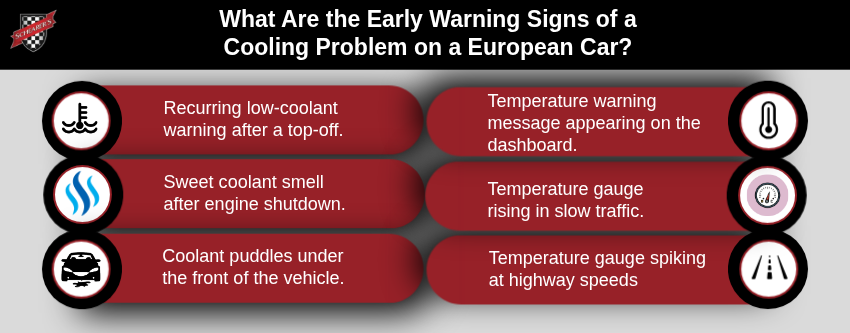
What are the early warning signs of a cooling problem on a European car?
The earliest sign is usually a low-coolant warning that returns a week or two after a top-off – that pattern almost always means an active leak, not normal consumption. A faint sweet smell after shutdown, or a small puddle of pink, orange, or blue-green fluid under the front, points to escaping coolant. Many European cars also flash a temperature warning before the gauge moves dramatically, because the engine management monitors coolant temperature continuously.
A gauge that climbs in slow traffic but settles at highway speed often indicates a failing electric fan or a blocked radiator rather than a leak. A gauge that spikes on the highway may signal a stuck thermostat or a water pump no longer circulating effectively. These distinctions matter because each points to a different repair, and guessing wrong wastes money. Contact Schearer’s Sales and Service in Allentown to have the symptom diagnosed accurately.
What does an overheating event actually do to a European engine?
This is where summer cooling failures become expensive. Aluminum cylinder heads, used by nearly every modern European engine, warp when they exceed their designed temperature. A head that warps even a few thousandths of an inch breaks the head-gasket seal, letting coolant and combustion gases mix. The repair then escalates from a couple hundred dollars of cooling parts to a head gasket job that may require machining the head – often a four-figure repair.
The damage can occur in minutes. A driver who keeps going “just to get home” with the gauge in the red frequently turns a repairable situation into engine-replacement territory. The correct response is to pull over safely, shut off, and let it cool – then have the car inspected before driving further. Acting on the first warning is what keeps these repairs small.
How can Allentown drivers prevent a summer cooling failure?
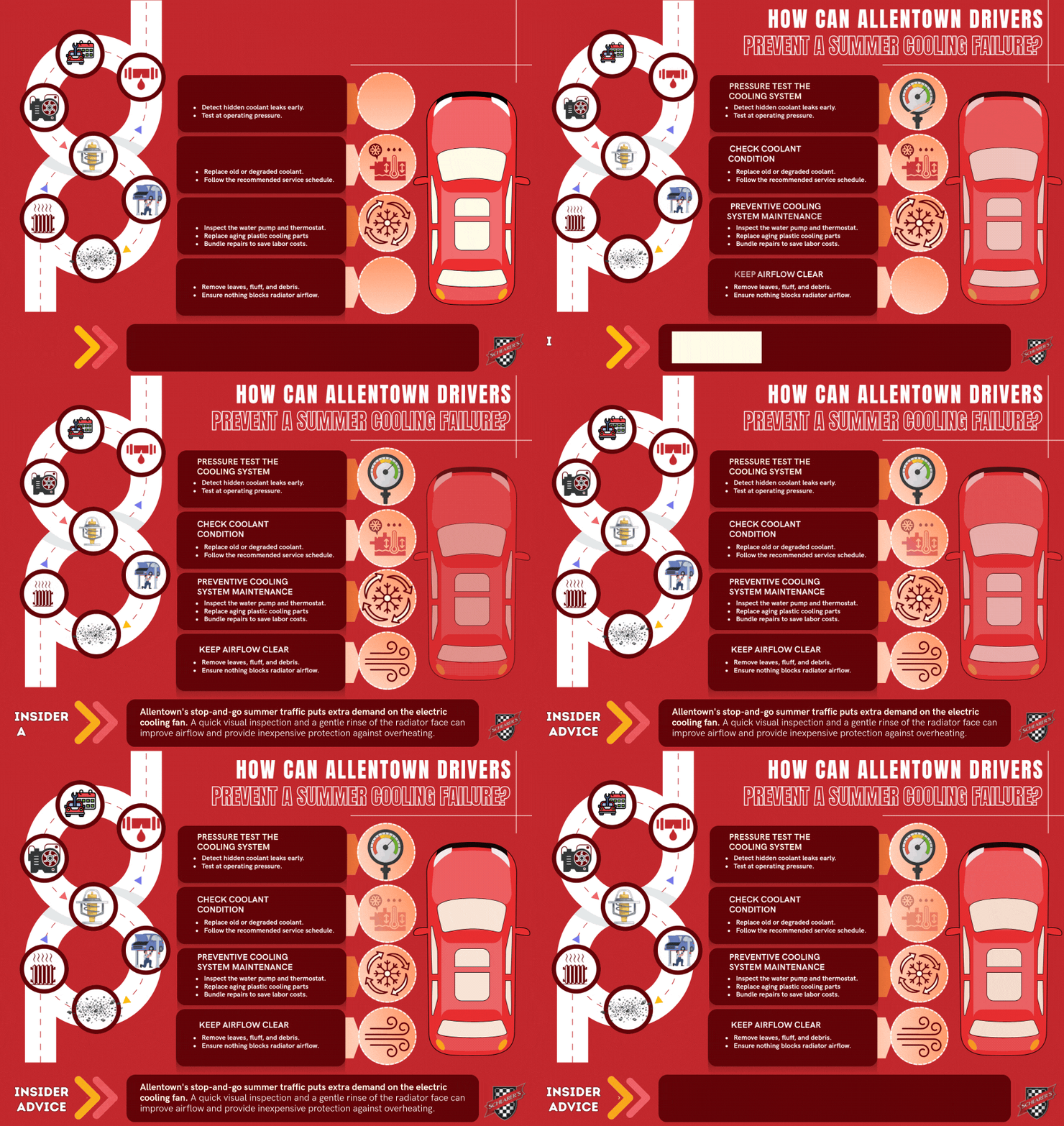
The most effective prevention is a pressure test combined with a coolant condition check before the heat arrives. A pressure test pumps the system to operating pressure and holds it, revealing leaks invisible when the engine is cold. Coolant aged past its interval loses its corrosion inhibitors and boiling-point protection, so testing the fluid and replacing it on schedule is equally important. Schedule a cooling system inspection at Schearer’s Sales and Service in Allentown and address weaknesses on your timeline.
On higher-mileage German cars, many shops replace the water pump, thermostat, and the most failure-prone plastic parts together once the car passes 90,000 to 100,000 miles. Because most labor overlaps, bundling is far cheaper than replacing each part as it fails – and it removes the summer-breakdown risk entirely.
Frequently Asked Questions
Q: Does Schearer’s Sales and Service perform cooling system pressure testing on European cars?
A: Yes – Schearer’s pressure tests the cooling system to locate leaks, checks coolant condition, and inspects the water pump, thermostat, and plastic components for the failure modes common on European engines. Contact the shop to schedule.
Q: How often should the coolant be replaced on a European vehicle?
A: Intervals vary by manufacturer and coolant type, but many European cars call for replacement between four and ten years or a set mileage. Schearer’s can confirm the correct interval and specification and test the current fluid.
Q: My temperature gauge is normal but I keep losing coolant – what does that mean?
A: A normal gauge with ongoing coolant loss usually points to a small external or internal leak that has not yet affected temperature. It should be diagnosed promptly, because a slow leak in summer can become a sudden one. Schearer’s can pressure-test the system.
Q: Does Schearer’s Sales and Service work on European brands besides BMW and Audi?
A: Yes – Schearer’s services Mercedes, Volkswagen, Porsche, Volvo, MINI, Jaguar, and Land Rover, along with Tesla and other EVs. Contact the shop to confirm availability.
Contact
Schearer’s Sales and Service
5530 Crackersport Rd, Allentown, PA 18104
Phone: (610) 395-2514
Website: schearers.com
Hours: Monday-Thursday 7:30 AM – 6:00 PM; Friday-Sunday Closed